Produktbeschreibung
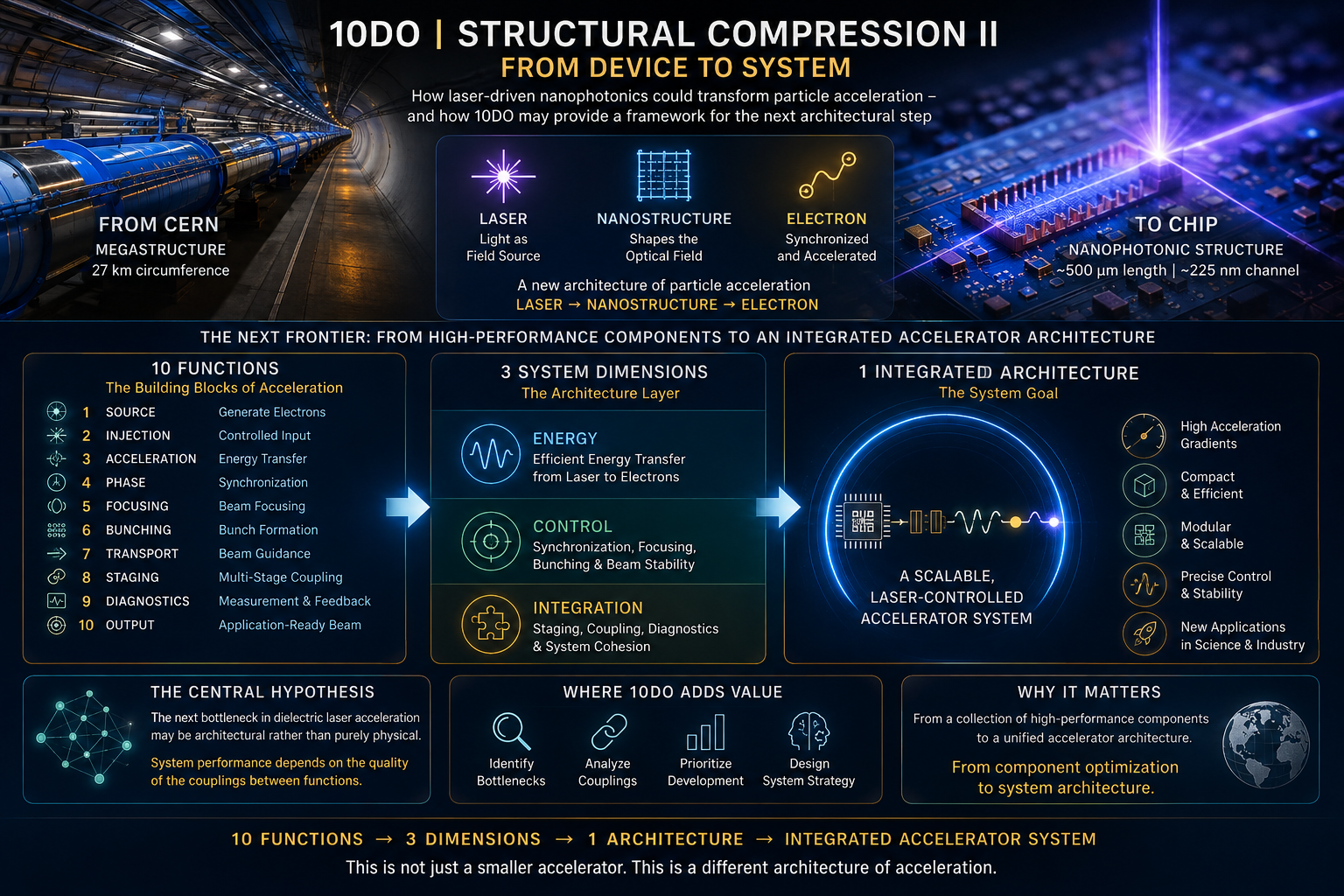
10DO | STRUCTURAL COMPRESSION II – FROM DEVICE TO SYSTEM
How 10DO Could Help Structure the Next Development Stage of Dielectric Laser Acceleration
The development of Dielectric Laser Acceleration (DLA) points toward a fundamentally different architecture for particle acceleration.
Large accelerator facilities such as CERN’s LHC achieve performance through enormous physical infrastructure. DLA follows another path: laser light, nanophotonic structures and precisely controlled electron beams compress a central acceleration function into an extremely small physical environment.
But the next challenge may no longer be acceleration alone.
The decisive question is how acceleration, injection, phase control, focusing, bunching, transport, staging, diagnostics and output can be connected into a coherent and scalable system.
This analysis introduces the 10DO perspective:
10 FUNCTIONS → 3 SYSTEM DIMENSIONS → 1 INTEGRATED ARCHITECTURE → SCALABLE SYSTEM
The ten functions provide a functional map of the accelerator system. They are condensed into three strategic dimensions:
ENERGY – efficient transfer of laser energy to electrons
CONTROL – synchronization, focusing, bunching, transport and beam stability
INTEGRATION – coupling, staging, diagnostics and overall system cohesion
The central hypothesis is that the next bottleneck in DLA may increasingly become architectural rather than purely physical.
As individual components become more capable, the critical challenge may shift toward the interfaces between them. A high-performance acceleration stage is not sufficient if transmission, synchronization, focusing or stage-to-stage coupling prevent the overall system from scaling.
This creates a different unit of analysis:
From component optimization to system optimization.
The report examines how 10DO could potentially contribute as a higher-level analytical and research architecture – not by replacing accelerator physics, simulation or experimental validation, but by making functional dependencies, bottlenecks and critical couplings more visible.
The analysis develops a possible 10DO DLA System Map, a Bottleneck & Coupling Matrix and a seven-stage development roadmap from a stable single DLA module toward a scalable accelerator architecture.
The scientific basis includes experimental work on nanophotonic electron acceleration, optical near-field control, dielectric laser acceleration, programmable optical control and the development of multi-stage accelerator concepts.
The central proposition remains deliberately testable:
Can 10DO help transform dielectric laser acceleration from a collection of high-performance components into a scalable accelerator architecture?
This is not a prediction of a future commercial accelerator. It is a structured hypothesis about the next level of technological development.
What this analysis explores
- The transition from CERN megastructure to nanophotonic accelerator
- The concept of Structural Compression
- The ten essential accelerator functions
- The compression from 10 → 3 → 1
- The role of the laser as a potential control medium
- Critical system couplings and bottlenecks
- The transition from Device → System
- A possible 10DO DLA System Map
- A Bottleneck & Coupling Matrix
- A seven-stage DLA Research Roadmap
- The potential role of 10DO as a research and system architecture
Why it matters
The important question may no longer be:
How powerful can a single accelerator component become?
It may increasingly be:
How many high-performance functions can operate together as one stable, controllable and scalable system?
The answer could determine whether structural compression becomes more than miniaturization – and whether it can become a fundamentally different architecture of acceleration.
10DO | SCIENCE ANALYSIS
Extended Research Edition | September 2026