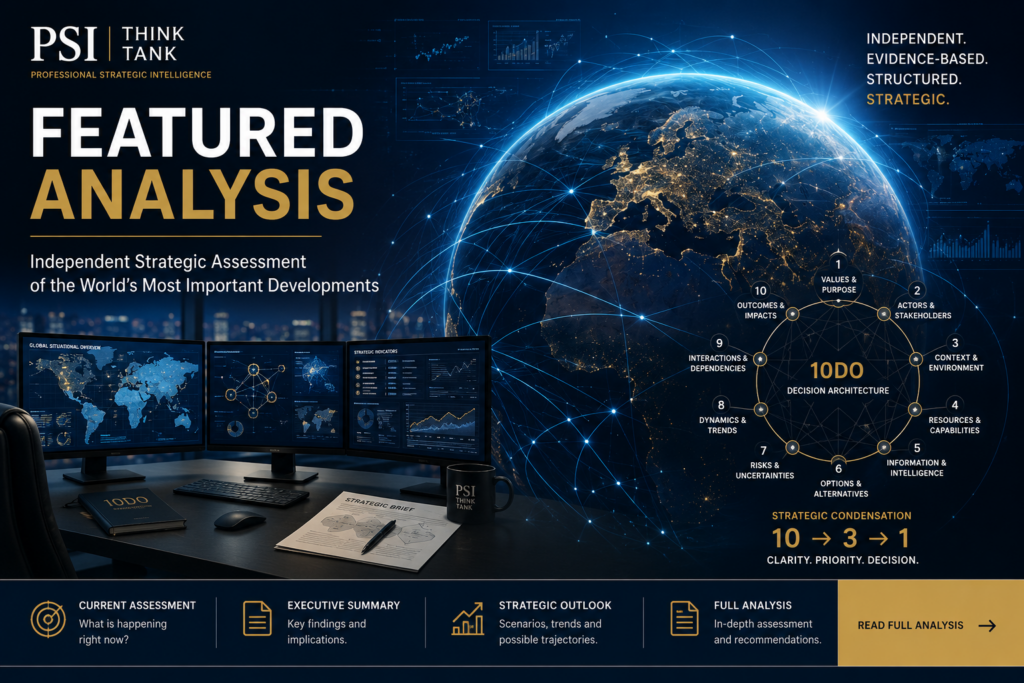
PSI THINK TANK
PSI Strategic Insight No. 001
Artificial General Intelligence (AGI)
Strategic Implications for Global Governance and Decision Architecture
Publication Date July 2026
Prepared by PSI Think Tank – Professional Strategic Intelligence
Framework 10DO Framework – Structural Decision Architecture
Assessment Level Independent Public Strategic Assessment
Version 1.0
Executive Summary
This Featured Analysis presents PSI Think Tank’s independent assessment of Artificial General Intelligence (AGI) and its strategic implications for global governance, institutional resilience, and decision architecture.
Applying the 10DO Framework, this analysis integrates multidisciplinary research, structural mapping, and strategic decision architecture to identify key dynamics, risks, opportunities, and actionable strategic recommendations.
The purpose of the 10DO Decision Architecture is not to replace human judgment with artificial intelligence, but to strengthen responsible human decision-making through structured strategic analysis. AGI enhances analytical capability, while accountability, ethical responsibility, and final strategic authority remain with human decision-makers. This human-centered governance principle constitutes the foundation of the present assessment.
Analysis Information
Topic: Artificial General Intelligence (AGI) Governance
Region: Global
Methodology: 10DO Structural Decision Architecture Framework
Assessment Level: Public
Prepared by: PSI Think Tank
Last Updated: June 2026
Current Assessment
Overview of the current situation, key developments, principal actors, and emerging strategic dynamics.
Strategic Contex
Artificial General Intelligence (AGI) is emerging within a period of profound structural transformation affecting the international system. Rapid advances in artificial intelligence coincide with intensifying geopolitical competition, accelerating technological innovation, economic realignment, and increasing institutional complexity. Unlike previous technological revolutions, AGI has the potential to influence virtually every strategic domain simultaneously, including national security, scientific research, industrial production, healthcare, finance, education, and public administration.
The strategic environment is increasingly shaped by global competition for technological leadership. Governments, multinational corporations, research institutions, and private investors are committing unprecedented resources to AGI development, recognizing that technological superiority will become a decisive factor in economic competitiveness, geopolitical influence, and national resilience throughout the twenty-first century.
At the same time, governance structures remain fragmented. Regulatory approaches differ significantly across jurisdictions, while internationally accepted standards for safety, transparency, accountability, and strategic oversight are still evolving. This widening gap between technological capability and institutional preparedness increases systemic uncertainty and complicates long-term strategic decision-making.
From the perspective of the 10DO Decision Architecture, AGI should not be understood merely as an emerging technology but as a structural transformation of the global decision environment. Effective governance therefore requires more than technological innovation; it requires decision architectures capable of integrating scientific progress, institutional responsibility, geopolitical realities, and human strategic judgment into a coherent framework for responsible action.
Current Situation
Artificial General Intelligence remains under active development, yet its strategic influence is already shaping global policy, investment, research, and security planning. Leading technology companies, supported by unprecedented computational resources and financial investment, continue to expand the capabilities of large-scale AI systems at an accelerating pace.
Governments increasingly recognize AGI as a strategic national asset. Major powers are integrating artificial intelligence into national security strategies, industrial policies, scientific research programs, and critical infrastructure planning. Competition for advanced semiconductor technologies, computing capacity, specialized talent, and strategic data resources has intensified significantly, reinforcing the global race for technological leadership.
International organizations and regulatory authorities are simultaneously seeking to establish governance frameworks that promote innovation while addressing safety, transparency, accountability, and ethical oversight. However, regulatory progress remains uneven, reflecting differing political priorities, economic interests, and national security considerations across regions.
Public awareness of AGI has also increased substantially. While expectations regarding scientific progress, economic growth, and societal benefits continue to expand, concerns surrounding employment, misinformation, cybersecurity, autonomous decision-making, and loss of human control have become central topics within public debate.
Overall, the current situation is characterized by rapid technological progress combined with growing institutional uncertainty. The pace of innovation increasingly exceeds the speed at which governance structures can adapt, creating a strategic environment in which opportunities and risks continue to evolve simultaneously.
Strategic Significance
Artificial General Intelligence represents far more than the next stage of technological innovation. Its strategic significance lies in its potential to transform the architecture of decision-making across governments, industries, scientific institutions, and international organizations. As AGI becomes increasingly integrated into critical infrastructures and strategic processes, the quality of governance will become as important as the capability of the technology itself.
Unlike previous technological revolutions, AGI possesses the capacity to influence multiple strategic domains simultaneously. Economic competitiveness, military planning, scientific research, healthcare, education, cybersecurity, and public administration are becoming increasingly interconnected through intelligent systems. Consequently, isolated policy responses are unlikely to provide sustainable solutions.
From the perspective of the 10DO Decision Architecture, the principal challenge is not the emergence of AGI itself, but the absence of comprehensive decision architectures capable of integrating technological capability with human responsibility, institutional accountability, and long-term strategic judgment. Without such structures, increasing complexity may exceed the capacity of existing governance systems to respond effectively.
The strategic significance of AGI therefore extends beyond technology. It concerns the future balance between innovation and governance, automation and accountability, analytical capability and human judgment. The societies most likely to benefit from AGI will not necessarily be those possessing the most advanced technologies, but those capable of integrating technological intelligence within resilient, transparent, and human-centered decision architectures.
For this reason, the 10DO Framework considers Artificial General Intelligence not as a replacement for human strategic leadership, but as an instrument that strengthens responsible decision-making. Human judgment remains the final authority, while AGI provides the analytical capacity required to understand increasingly complex decision environments. This principle constitutes the foundation of sustainable governance in the age of intelligent systems.
Key Questions
- What structural factors are accelerating the development and global diffusion of Artificial General Intelligence?
- Which state and non-state actors will most significantly influence the future governance of AGI?
- How can governments preserve human responsibility while integrating increasingly autonomous intelligent systems into strategic decision-making?
- What are the principal geopolitical, economic, technological, and societal risks associated with AGI over the next decade?
- Which strategic governance architectures are most capable of balancing innovation, security, accountability, and international stability?
- How can the 10DO Decision Architecture contribute to resilient, transparent, and human-centered governance in the age of Artificial General Intelligence?
Structural Analysis (10DO)
10DO Field 1 — Context & Environment
Artificial General Intelligence (AGI) is emerging within an increasingly complex global environment characterized by rapid technological innovation, intensifying geopolitical competition, economic transformation, and evolving governance challenges. Unlike previous digital technologies, AGI has the potential to influence virtually every strategic domain simultaneously, including national security, scientific research, industrial production, healthcare, finance, education, public administration, and military capabilities.
The strategic environment is increasingly shaped by a global competition for technological leadership. Governments, multinational corporations, research institutions, and private investors are committing unprecedented resources to advanced AI research, recognizing that leadership in AGI may become a defining factor of economic competitiveness, geopolitical influence, and long-term national resilience throughout the twenty-first century.
At the same time, institutional governance remains fragmented. Regulatory approaches differ significantly across regions, while internationally accepted standards for AGI safety, transparency, accountability, and risk management are still in an early stage of development. This widening gap between technological capability and institutional preparedness increases strategic uncertainty and complicates effective global coordination.
The broader environment is further influenced by structural trends such as digital globalization, expanding computational infrastructure, the exponential growth of data availability, advances in semiconductor technologies, autonomous systems, quantum computing, and increasingly sophisticated human–machine collaboration. These developments reinforce one another, accelerating technological transformation beyond the adaptive capacity of many traditional political and governance structures.
Within this strategic context, AGI should not be regarded merely as another emerging technology. It represents a structural transformation affecting political authority, economic organization, scientific innovation, military strategy, labor markets, and societal resilience. Effective strategic assessment therefore requires a multidimensional decision architecture capable of integrating technological, geopolitical, economic, institutional, and ethical perspectives into a coherent analytical framework.
From a 10DO perspective, the Context & Environment field establishes the structural conditions under which all subsequent decision factors evolve. Understanding this environment provides the essential foundation for evaluating stakeholders, resources, governance structures, risks, and future strategic pathways throughout the remainder of the assessment.
10DO Field 2 – Key Actors & Stakeholders
Artificial General Intelligence (AGI) has evolved beyond the exclusive domain of scientific research to become a central arena of global strategic competition. Governments, technology companies, research institutions, international organizations, private investors, and civil society increasingly compete, cooperate, and influence the future direction of AGI development. Each stakeholder pursues distinct objectives, operates within different institutional constraints, and contributes to shaping the emerging global decision environment.
National governments regard AGI as a strategic capability with profound implications for economic competitiveness, national security, technological sovereignty, and geopolitical influence. Leading powers—including the United States, China, the European Union, and other technologically advanced nations—are making substantial long-term investments in AI research, digital infrastructure, education, and regulatory capacity. Their strategic priorities increasingly shape the international governance landscape within which AGI evolves.
Private technology companies have become the primary drivers of innovation. Large-scale investments in foundation models, semiconductor technologies, cloud computing, robotics, and advanced computational infrastructure have positioned a relatively small number of global corporations at the forefront of technological development. Their strategic decisions increasingly influence international standards, market structures, research priorities, and the pace of global innovation.
Research institutions and universities continue to provide the scientific foundation for AGI through advances in machine learning, cognitive architectures, robotics, neuroscience, mathematics, and computer science. At the same time, collaboration between academia and industry has intensified, accelerating technological progress while raising important questions concerning openness, intellectual property, research independence, and the commercialization of scientific knowledge.
International organizations, regulatory authorities, and standards bodies play an increasingly important role in establishing governance principles, ethical guidelines, safety standards, and mechanisms for international cooperation. Their ability to coordinate across political systems, legal frameworks, and technological ecosystems will significantly influence whether AGI develops within stable global governance structures or under fragmented regulatory competition.
Society itself represents a decisive strategic stakeholder. Businesses, labor markets, educational institutions, healthcare systems, public administrations, and individual citizens will experience profound structural transformation as AGI becomes increasingly integrated into everyday economic and social life. Public trust, workforce adaptation, institutional resilience, and democratic legitimacy will therefore become critical determinants of both the opportunities and the risks associated with advanced artificial intelligence.
From a 10DO perspective, stakeholders should not be viewed as isolated actors but as interconnected components of a dynamic decision ecosystem. Strategic outcomes emerge through the continuous interaction of political authority, technological capability, economic incentives, institutional governance, scientific innovation, and societal acceptance. Understanding these structural interdependencies is essential before evaluating available resources, emerging risks, future scenarios, or strategic options.
Within the 10DO Decision Architecture, this field identifies who shapes the strategic environment established in Field 1. The following field examines the resources and capabilities that determine how effectively these actors can translate strategic intent into long-term influence and decision-making capacity.
10DO Field – 3 Resources & Capabilities
The strategic advancement of Artificial General Intelligence (AGI) depends fundamentally on the availability, coordination, and effective integration of critical resources and capabilities. Unlike previous technological revolutions, AGI development requires the simultaneous combination of computational infrastructure, scientific expertise, financial investment, institutional capacity, regulatory competence, and access to trusted, high-quality data. No single resource alone is sufficient to achieve sustainable strategic leadership.
Computational infrastructure has become one of the defining strategic assets of the AI era. Advanced semiconductor manufacturing, high-performance computing facilities, cloud infrastructure, reliable energy supply, and secure digital networks determine the scale at which increasingly sophisticated AI models can be developed, trained, and deployed. As computational demands continue to expand, digital infrastructure is evolving into a geopolitical resource comparable in strategic importance to energy systems, transportation networks, and critical raw materials.
Human capital represents an equally decisive capability. The availability of highly qualified researchers, engineers, data scientists, cybersecurity specialists, and interdisciplinary experts directly determines innovation capacity and long-term competitiveness. Educational excellence, international talent mobility, research investment, and the ability to attract and retain world-class expertise increasingly differentiate nations and organizations competing within the global AGI landscape.
Financial resources provide the foundation for sustained technological progress. Public investment programs, private capital, venture financing, corporate research budgets, and international partnerships enable continuous experimentation, large-scale model development, and accelerated innovation cycles. The substantial financial requirements associated with frontier AI research have simultaneously increased the concentration of technological capability within a relatively limited number of governments and global technology companies.
Institutional capability has become an equally important strategic resource. Governments and public institutions require regulatory expertise, strategic planning capacity, digital governance mechanisms, cybersecurity resilience, and effective administrative structures capable of managing both the opportunities and the systemic risks associated with increasingly autonomous intelligent systems. Institutions unable to adapt to this rapidly evolving environment risk losing their capacity for effective strategic oversight.
Data quality and information integrity constitute another essential pillar of sustainable AGI development. High-quality datasets, trusted information environments, secure data governance, and effective knowledge management directly influence the reliability, transparency, and performance of advanced AI systems. At the same time, growing concerns regarding privacy, intellectual property, misinformation, cyber manipulation, and data sovereignty demand increasingly sophisticated governance frameworks capable of balancing innovation with accountability.
From a 10DO perspective, strategic capability is not defined by the possession of individual resources but by their successful structural integration. Sustainable strategic advantage emerges when technological infrastructure, scientific expertise, financial capacity, institutional effectiveness, regulatory maturity, and trusted information systems reinforce one another within a coherent decision architecture. It is this structural coherence—not isolated technological superiority—that determines long-term resilience and strategic effectiveness.
Within the 10DO Decision Architecture, this field explains how strategic actors transform available resources into operational capability. The following field examines how information and strategic intelligence guide these capabilities toward responsible, evidence-based, and accountable decision-making.
10DO Field – 4 Information & Intelligence
The strategic evolution of Artificial General Intelligence (AGI) is fundamentally driven by the generation, processing, validation, and application of information. However, the strategic value of information is determined not by its quantity but by its quality, reliability, contextual relevance, and its capacity to support responsible decision-making. In an increasingly complex strategic environment, information superiority is achieved through understanding rather than accumulation.
The global AGI ecosystem generates unprecedented volumes of information derived from scientific research, digital communications, industrial systems, financial markets, public administration, and human interaction. While this expanding information landscape creates exceptional opportunities for innovation and strategic insight, it simultaneously increases the risks of misinformation, disinformation, analytical fragmentation, and cognitive overload. Strategic decision-makers must therefore distinguish clearly between the availability of information and the creation of actionable intelligence.
Reliable strategic intelligence requires systematic validation, multidisciplinary analysis, and continuous assessment of information sources. Governments, research institutions, international organizations, and private-sector leaders increasingly depend on integrated intelligence capabilities that identify technological developments, geopolitical shifts, systemic risks, and long-term structural trends before they become critical strategic challenges. Incomplete, fragmented, or poorly validated information significantly increases the probability of strategic misjudgment.
Transparency represents another essential dimension of effective AGI governance. As intelligent systems become more autonomous and influential, understanding the origin of data, the design of algorithms, model behavior, and decision processes becomes indispensable for accountability, public trust, and institutional legitimacy. Explainability, traceability, and independent verification are therefore strategic governance requirements rather than merely technical objectives.
Cybersecurity and information integrity further determine the resilience of intelligent systems. AI infrastructures may become targets of cyberattacks, model manipulation, intellectual property theft, disinformation campaigns, and coordinated influence operations. Protecting strategic information assets while preserving the integrity, confidentiality, and availability of critical data has therefore become a fundamental requirement for national resilience and international security.
From the perspective of the 10DO Decision Architecture, the highest value of information lies not in data collection but in its structured transformation into strategic intelligence. The progression from data to information, from information to validated knowledge, and from knowledge to responsible strategic judgment constitutes the core analytical process of the 10DO Framework. Artificial intelligence significantly enhances this process by expanding analytical capability; however, the evaluation of strategic significance, ethical implications, and final decision authority remains the responsibility of accountable human decision-makers.
Within the 10DO Decision Architecture, this field transforms available resources into strategic understanding. The following field examines how uncertainty emerges when information, technology, governance, and human decision-making interact within increasingly complex strategic environments.
10DO Field – 5 Risks & Uncertainties
Artificial General Intelligence (AGI) presents unprecedented opportunities for scientific progress, economic development, and societal advancement. At the same time, its rapid evolution introduces a broad spectrum of strategic risks whose complexity extends far beyond traditional technological risk assessment. These uncertainties emerge not only from the capabilities of intelligent systems themselves but from the interaction between technology, governance, geopolitical competition, economic transformation, and human decision-making.
One of the most significant risks is the growing imbalance between technological progress and institutional adaptation. While AGI capabilities continue to advance at an accelerating pace, regulatory frameworks, legal systems, public administration, and international governance mechanisms evolve considerably more slowly. This widening gap creates structural governance deficits in which increasingly powerful technologies may be deployed before adequate oversight, accountability, and safety mechanisms are fully established.
Geopolitical competition represents another major source of uncertainty. Nations increasingly regard AGI as a strategic asset influencing economic competitiveness, military capability, intelligence operations, and international influence. The resulting race for technological leadership may reduce incentives for international cooperation while encouraging accelerated deployment under conditions where strategic caution and long-term safety receive insufficient attention. Strategic mistrust between major powers further complicates the development of internationally accepted governance standards.
Economic and societal uncertainties are equally profound. AGI is expected to transform labor markets, industrial production, education, healthcare, financial systems, and public administration at an unprecedented pace. While new opportunities for innovation and productivity will emerge, transitional disruptions may intensify economic inequality, workforce displacement, regional disparities, and social polarization if institutional adaptation fails to keep pace with technological change.
Technical uncertainties remain substantial despite continuing scientific progress. Challenges relating to system reliability, robustness, explainability, alignment, cybersecurity, autonomous decision-making, and unintended system behavior continue to require intensive interdisciplinary research. As increasingly capable AI systems become interconnected across critical infrastructures, localized technical failures may generate disproportionately large systemic consequences.
From the perspective of the 10DO Decision Architecture, the greatest long-term uncertainty does not arise from AGI itself but from the absence of decision architectures capable of governing increasing technological complexity. Technology does not create strategic stability automatically; stability emerges only when innovation is accompanied by responsible governance, institutional resilience, transparent accountability, and informed human judgment. The central challenge is therefore not controlling intelligence, but strengthening the quality of strategic decision-making.
Within the 10DO Framework, risks should never be evaluated as isolated events. They represent interconnected structural dynamics operating simultaneously across technological, political, economic, institutional, and societal domains. Effective strategic assessment therefore requires continuous observation of systemic interactions, cascading effects, and emerging uncertainties. The following field examines how these risks can be addressed through alternative strategic pathways and coordinated decision options.
10DO Field – 6 Strategic Options
The growing strategic significance of Artificial General Intelligence (AGI) requires decision-makers to move beyond reactive policy responses toward proactive, structured, and long-term decision-making. Given the complexity, uncertainty, and global implications of AGI, no single strategy can adequately address all technological, political, economic, and societal challenges. Sustainable governance therefore requires the systematic evaluation of multiple strategic pathways rather than reliance on isolated policy measures.
One strategic option emphasizes technological leadership through sustained investment in research, education, computational infrastructure, and industrial innovation. This approach seeks to strengthen scientific excellence, economic competitiveness, and national resilience while maintaining long-term technological sovereignty. Its success, however, depends upon effective institutional coordination and continuous investment in human expertise.
A second strategic option prioritizes governance capacity and institutional resilience. Rather than focusing exclusively on technological superiority, this approach seeks to establish transparent legal frameworks, accountable regulatory systems, international standards, and adaptive governance mechanisms capable of supporting innovation while preserving public trust and democratic legitimacy. Strong governance does not constrain technological progress; it enables its responsible and sustainable application.
A third strategic pathway emphasizes international cooperation. Because AGI development transcends national borders, governments, research institutions, industry, and international organizations share a common interest in promoting safety standards, scientific collaboration, information exchange, and coordinated governance principles. While geopolitical competition will remain an enduring reality, strategic cooperation in selected areas can reduce systemic risks and strengthen global stability.
A fourth strategic option focuses on resilience and adaptive capacity. Instead of attempting to predict every technological breakthrough, institutions should strengthen their ability to respond effectively to unexpected developments. Investment in education, workforce transformation, cybersecurity, digital infrastructure, institutional learning, and continuous strategic assessment enables societies to remain resilient under conditions of accelerating technological change.
From the perspective of the 10DO Decision Architecture, these strategic options should not be viewed as competing alternatives but as complementary components of an integrated governance strategy. Technological capability, institutional resilience, international cooperation, regulatory effectiveness, and societal adaptation reinforce one another when coordinated within a coherent decision architecture. The objective is therefore not to identify a single optimal solution, but to establish a structured decision process capable of balancing competing priorities, evaluating strategic trade-offs, and adapting to evolving circumstances.
Within the 10DO Framework, strategic options represent alternative pathways rather than predetermined outcomes. The role of structured decision architecture is to compare these pathways objectively, identify their long-term implications, and support responsible human decision-making. The following field examines the dynamic forces and long-term trends that continuously reshape these strategic options over time.
10DO Field – 7 Dynamics & Trends
The evolution of Artificial General Intelligence (AGI) is characterized by accelerating technological, economic, geopolitical, institutional, and societal dynamics that continuously reshape the global strategic environment. These developments should not be interpreted as isolated trends but as interconnected structural processes that influence one another across multiple domains. Understanding these evolving dynamics is essential for anticipating future challenges rather than merely responding to current events.
Technological innovation continues to accelerate at an unprecedented pace. Advances in foundation models, multimodal systems, robotics, autonomous decision-support systems, semiconductor technologies, quantum computing, and distributed computing architectures reinforce one another, creating exponential growth in analytical capability. As innovation cycles become increasingly compressed, governments and institutions face growing challenges in maintaining effective strategic oversight and adaptive governance.
Geopolitical competition is emerging as one of the defining structural dynamics of AGI development. Nations increasingly recognize artificial intelligence as a strategic capability influencing economic competitiveness, technological sovereignty, national security, and international influence. This competition is expected to intensify investment in research, critical infrastructure, education, talent acquisition, and technological self-sufficiency, while simultaneously increasing the complexity of international cooperation.
Economic transformation represents another significant long-term trend. AGI will fundamentally reshape production systems, labor markets, financial services, healthcare, education, scientific research, logistics, and public administration. New industries and business models will emerge while existing economic structures undergo continuous adaptation. Organizations capable of integrating intelligent systems within resilient governance structures will achieve lasting strategic advantages.
Societal expectations are evolving at the same pace. Citizens increasingly expect transparency, accountability, privacy protection, fairness, and ethical governance in the deployment of intelligent systems. Public confidence will therefore become a strategic asset influencing technology adoption, institutional legitimacy, and long-term social stability. Responsible governance must consequently evolve alongside technological capability.
Institutional adaptation remains one of the decisive factors shaping the future strategic environment. Governments, international organizations, educational systems, and regulatory authorities are progressively transforming their structures to address increasingly complex technological realities. Their success will determine whether societies are able to govern AGI responsibly while preserving democratic values, innovation, and international cooperation.
From the perspective of the 10DO Decision Architecture, these developments represent continuous structural dynamics rather than isolated trends. Technological progress, political decisions, economic transformation, institutional resilience, and societal expectations interact through complex feedback mechanisms that continuously reshape the global decision environment. Effective strategic leadership therefore requires continuous reassessment, adaptive governance, and structured decision architectures capable of responding to changing conditions.
A fundamental principle of the 10DO Decision Architecture is that increasing analytical capability must never diminish human strategic responsibility. Artificial General Intelligence expands humanity’s capacity to understand complexity, identify patterns, and evaluate strategic alternatives. It does not replace human judgment. Final responsibility for balancing competing interests, evaluating long-term consequences, and making legitimate strategic decisions remains with accountable human institutions and decision-makers. In this way, the 10DO Framework strengthens human influence over AGI rather than allowing technological autonomy to diminish it.
Within the 10DO Framework, understanding long-term dynamics provides the basis for recognizing the structural interdependencies examined in the following field. Only by understanding how these dynamic processes interact can responsible long-term strategic decisions be achieved.
10DO Field – 8 Interdependencies
Artificial General Intelligence (AGI) is evolving within a highly interconnected global system in which technological progress, geopolitical competition, economic transformation, institutional governance, scientific innovation, and societal adaptation continuously influence one another. None of these domains can be understood in isolation. Strategic outcomes increasingly emerge from their interaction rather than from individual technological advances.
Technological innovation directly influences economic competitiveness, while economic investment simultaneously accelerates further technological development. Advances in semiconductor manufacturing, cloud infrastructure, quantum computing, cybersecurity, autonomous systems, and digital communications reinforce AGI capabilities, creating self-amplifying cycles of innovation. These developments reshape industrial competitiveness, national resilience, and international strategic influence.
Geopolitical dynamics further strengthen these structural interdependencies. National strategies concerning AI research, critical infrastructure, supply chains, talent development, digital sovereignty, and cybersecurity increasingly shape international alliances, strategic competition, and global stability. Decisions taken by one nation or economic bloc frequently generate immediate political, economic, and technological consequences far beyond their original sphere of influence.
Institutional governance represents another critical layer of interaction. Regulatory frameworks influence investment decisions, scientific research, innovation capacity, public trust, and international cooperation. At the same time, technological progress continuously challenges existing legal systems, educational institutions, labor markets, and public administration, requiring permanent institutional adaptation and strategic learning.
Societal acceptance constitutes an equally important structural dependency. Public confidence in intelligent systems influences political legitimacy, regulatory effectiveness, workforce transformation, educational reform, economic adoption, and democratic stability. Conversely, transparent governance, accountable institutions, ethical leadership, and responsible human oversight strengthen public trust and increase the long-term sustainability of technological innovation.
From the perspective of the 10DO Decision Architecture, these interdependencies form the structural architecture of the strategic decision environment. Effective governance cannot optimize isolated variables independently. Instead, it must continuously evaluate the relationships between political authority, technological capability, economic resilience, institutional effectiveness, scientific progress, and societal stability. Sustainable strategic advantage emerges not from maximizing individual components but from maintaining structural coherence across the entire decision architecture.
A central principle of the 10DO Framework is that increasing technological autonomy must never be confused with transferring strategic authority. As interdependencies become more complex, AGI should strengthen humanity’s understanding of systemic relationships rather than replace human judgment. The purpose of structured decision architecture is to preserve accountable human leadership by enabling decision-makers to comprehend complex interactions, evaluate long-term consequences, and maintain responsible governance within an increasingly interconnected world.
Within the 10DO Decision Architecture, understanding these structural interdependencies provides the foundation for anticipating long-term strategic outcomes. The following field therefore examines the expected consequences that may emerge when these interconnected dynamics continue to evolve over time.
10DO Field 9 Expected Outcomes
Artificial General Intelligence (AGI) is expected to become one of the defining structural forces shaping the global strategic environment throughout the coming decades. Although the precise trajectory of its development cannot be predicted with certainty, current technological, political, economic, and societal dynamics already indicate several highly probable long-term outcomes.
The first expected outcome is the progressive integration of AGI into virtually every strategic sector of society. Public administration, healthcare, education, scientific research, industrial production, financial services, defense, transportation, and critical infrastructure are expected to become increasingly supported by intelligent systems capable of performing highly complex analytical and operational functions. This transformation will fundamentally redefine productivity, competitiveness, institutional effectiveness, and strategic planning.
A second likely outcome is the emergence of a new equilibrium between technological innovation and governance. As AGI capabilities continue to expand, governments, international organizations, and regulatory authorities will be required to establish increasingly sophisticated governance structures, ethical standards, accountability mechanisms, and international cooperation frameworks. Long-term stability will therefore depend not only on technological progress but equally on the maturity of institutional governance.
Economic transformation will continue to accelerate. Labor markets are expected to shift toward knowledge-intensive, interdisciplinary, and human-centered activities, while repetitive analytical and operational tasks become progressively automated. Organizations capable of combining technological innovation with adaptive leadership, continuous learning, institutional resilience, and responsible governance will achieve sustainable strategic advantages.
International relations will become increasingly influenced by technological capability. Competition for advanced semiconductors, computational infrastructure, cybersecurity, digital sovereignty, scientific talent, and strategic data resources will play a growing role in determining geopolitical influence. At the same time, increasing global interdependence may encourage new forms of international cooperation in AI safety, standards development, scientific collaboration, and strategic governance.
From a societal perspective, long-term success will depend upon maintaining public confidence in intelligent systems. Transparent governance, ethical accountability, human oversight, education, and responsible innovation will become decisive factors determining whether AGI strengthens democratic institutions, economic resilience, and societal stability or contributes to fragmentation, polarization, and declining public trust.
From the perspective of the 10DO Decision Architecture, the most significant long-term outcome is not the replacement of human intelligence by artificial intelligence but the transformation of strategic decision-making itself. As complexity continues to increase, AGI will provide unprecedented analytical capability, while accountable human decision-makers retain responsibility for judgment, ethical evaluation, and strategic leadership. The future therefore depends less on autonomous technological capability than on humanity’s ability to integrate AGI within resilient decision architectures that preserve human responsibility while expanding collective intelligence.
The ultimate outcome will be determined not by technology alone, but by the quality of the strategic decisions guiding its development. Societies capable of integrating innovation, institutional resilience, international cooperation, and responsible human governance within a coherent decision architecture will be best positioned to realize the benefits of AGI while minimizing long-term systemic risks.
Within the 10DO Decision Architecture, these expected outcomes represent the final stage of the structural assessment. The following chapter transforms the insights generated across all ten analytical fields into strategic synthesis, strategic prioritization, and ultimately one coherent strategic decision.
10DO Field 10 Strategic Condensation
Phase I — Structural Synthesis (10)
The preceding analysis has examined Artificial General Intelligence (AGI) across ten interconnected structural domains of the 10DO Decision Architecture. Each field has contributed a distinct perspective on technological development, geopolitical competition, economic transformation, institutional governance, societal resilience, and long-term strategic uncertainty. Considered individually, these fields provide valuable analytical insights. Considered collectively, they reveal the structural architecture of the strategic decision environment.
From the perspective of the 10DO Decision Architecture, strategic understanding does not emerge from isolated observations but from the systematic integration of multiple structural dimensions into a coherent analytical framework. The purpose of structural synthesis is therefore not to reduce complexity, but to organize complexity into an intelligible structure that supports responsible strategic judgment.
Structural synthesis transforms fragmented observations into an integrated understanding of the strategic environment. It enables decision-makers to recognize systemic relationships, identify structural dependencies, distinguish short-term events from long-term developments, and establish the analytical foundation required for informed strategic decisions.
Phase II — Strategic Prioritization (3)
Following structural synthesis, the integrated assessment is condensed into three overarching strategic priorities that define the future governance of Artificial General Intelligence.
Strategic Axis I – Innovation and Technological Capability
The capacity to develop, govern, and responsibly deploy AGI while maintaining scientific excellence, technological competitiveness, resilient infrastructure, and sustainable long-term innovation.
Strategic Axis II – Governance and Institutional Resilience
The capacity to develop, govern, and responsibly deploy AGI while maintaining scientific excellence, technological competitiveness, resilient infrastructure, and sustainable long-term innovation.
Strategic Axis III – Global Cooperation and Civilizational Stability
The capability to balance geopolitical competition with international cooperation in order to promote global stability, shared security, sustainable development, responsible innovation, and long-term civilizational resilience.
The purpose of strategic prioritization is not to simplify reality but to identify the structural priorities that require continuous strategic attention. These three axes provide the conceptual bridge between comprehensive analysis and responsible strategic decision-making.
Phase III — Strategic Decision (1)
The structural assessment leads to one overarching strategic conclusion.
Artificial General Intelligence should not be understood as an autonomous decision-maker but as a strategic capability operating within a human-centered decision architecture.
Technological progress alone cannot guarantee stability, security, prosperity, or responsible governance. Long-term resilience depends upon preserving human responsibility, institutional accountability, ethical leadership, and transparent strategic decision-making.
Within the 10DO Decision Architecture, the objective is not to replace human judgment but to strengthen it. Artificial General Intelligence expands analytical capability, accelerates the evaluation of complex information, and improves strategic understanding. Responsibility for balancing competing interests, evaluating long-term consequences, and making legitimate strategic decisions remains with accountable human institutions and decision-makers.
The ultimate strategic objective is therefore the establishment of a governance architecture in which technological intelligence and human strategic judgment reinforce one another. In this model, AGI becomes an instrument for expanding human understanding rather than replacing human responsibility. This principle represents the central strategic conclusion of the present assessment and the defining philosophy of the 10DO Decision Architecture.
Phase IV — Human Responsibility
The structural assessment leads to one overarching strategic conclusion.
Artificial General Intelligence should not be understood as an autonomous decision-maker but as a strategic capability operating within a human-centered decision architecture.
Technological progress alone cannot guarantee stability, security, prosperity, or responsible governance. Long-term resilience depends upon preserving human responsibility, institutional accountability, ethical leadership, and transparent strategic decision-making.
Within the 10DO Decision Architecture, the objective is not to replace human judgment but to strengthen it. Artificial General Intelligence expands analytical capability, accelerates the evaluation of complex information, and improves strategic understanding. Responsibility for balancing competing interests, evaluating long-term consequences, and making legitimate strategic decisions remains with accountable human institutions and decision-makers.
The ultimate strategic objective is therefore the establishment of a governance architecture in which technological intelligence and human strategic judgment reinforce one another. In this model, AGI becomes an instrument for expanding human understanding rather than replacing human responsibility. This principle represents the central strategic conclusion of the present assessment and the defining philosophy of the 10DO Decision Architecture.
1. Strategic Outlook
Future scenarios, emerging opportunities, systemic risks, and possible strategic trajectories.
Future Scenarios
Assessment of the most plausible future developments and alternative strategic trajectories.
Future Scenarios
Scenario A – Cooperative Governance
International cooperation leads to common standards for safety, transparency, and responsible AGI development. Technological innovation and democratic oversight evolve in parallel.
Scenario B – Competitive Fragmentation
Geopolitical competition is accelerating AGI development in the absence of shared rules. National interests are overriding international cooperation and increasing systemic risks.
Scenario C – Autonomous Escalation
Decision-making processes are increasingly being automated, while institutional oversight mechanisms lag behind. Human accountability is being eroded, and strategic errors are becoming more likely.
Emerging Opportunities
Identification of opportunities arising from structural change, innovation, cooperation, or policy adaptation.
Artificial General Intelligence offers unprecedented opportunities for scientific research, healthcare, industrial productivity, education, disaster response, and strategic governance. Within the 10DO Framework, these opportunities become sustainable only when technological capability develops together with institutional resilience and accountable human decision-making.
Systemic Risks
Evaluation of long-term risks, cascading effects, and potential destabilizing factors.
The greatest long-term risk is not AGI itself but the absence of an adequate decision architecture capable of governing increasingly autonomous technological systems. Without structured strategic assessment, complexity may exceed institutional capacity to respond effectively.
Strategic Implications
Assessment of the consequences for governments, institutions, organizations, and strategic decision-makers.
Governments, international organizations, research institutions, and private-sector leaders should recognize that future competitiveness will depend not only on technological capability but on the quality of strategic governance. The central strategic challenge is therefore the development of decision architectures that preserve human responsibility while fully utilizing the analytical potential of Artificial General Intelligence.
Technological superiority without strategic governance may increase capability, but it does not guarantee societal stability.
2. Strategic Recommendations
Priority Actions
- Develop national AI governance strategies.
- Establish interdisciplinary AGI assessment councils.
- Integrate human oversight into critical decision systems.
- Expand strategic intelligence capabilities.
- Promote international standards for responsible AGI.
Recommended Policies
Policy recommendations designed to strengthen resilience, improve governance, enhance institutional effectiveness, and support long-term strategic objectives based on structural analysis.
Institutional Measures
Recommendations for governments, international organizations, public institutions, and private-sector partners to improve coordination, preparedness, information sharing, and strategic decision-making capacity.
Monitoring Priorities
Key indicators, emerging developments, structural changes, and critical uncertainties requiring continuous observation, periodic reassessment, and strategic review.
3. Related Strategic Insights
Related PSI Strategic Insights will be published as the PSI Think Tank Strategic Insight Series expands.
About this Analysis
Prepared by: PSI Think Tank
Framework: 10DO Structural Decision Architecture
Assessment Type: Independent Str tegic Assessment
Version: 1.0
Publication Date: July 2026
Citation: PSI Strategic Insight No. 001
Copyright:
© 2026 PSI Think Tank. All rights reserved.
Disclaimer:
This publication represents an independent strategic assessment prepared by PSI Think Tank using the 10DO Structural Decision Architecture.
The analysis is intended for research, education, public policy discussion, and strategic decision support. It does not constitute legal, financial, military, governmental, or investment advice.
While every effort has been made to ensure accuracy, objectivity, and methodological consistency, future developments remain inherently uncertain. The conclusions presented reflect the assessment available at the time of publication.